Forever protected
Some valleys and steep gullies beyond the shores of Ōhiwa Harbour are like hidden taonga many of us have no idea they exist. They contain remnants of almost original bush offering habitat for a diversity of trees and wildlife that is otherwise rare in the catchment. One of these treasures on the eastern side of the harbour is now protected in perpetuity under a Queen Elizabeth II National Trust (known as QE II) covenant. The current landowner, Coral Malcolm, had wanted to set aside this special part of her land for some time. Thanks to a collaborative effort that involved Coral, the local QE II rep Hōri Barsdell, Thomas Blackett from the Bay of Plenty Regional Council, and Mithuna Sothieson and Andrew Glaser from the Ōhiwa Headland Sanctuary Trust this has now been achieved. The vision from the outset was to link the remnant bush with the nearby Onekawa Te Mawhai Regional Park.
The 12ha area on land that has been farmed by three generations of the Reeve family is a priority biodiversity site for the Bay of Plenty Regional Council. It has beautiful mature Pūriri and Pohutukawa groves, as well as Titoki, Karaka, Kohekohe, Rewarewa, Mangeao, and a few Rimu and Miro.
Over 600m of fencing has already been completed to keep stock out of the protected area and allow the understory of the bush to regenerate. Throughout the ngahere (bush) bait stations to control rodents have been installed and will be maintained by the Ōhiwa Headland Sanctuary Trust through their pest control team of Laurie Matthews, Reuben Aikman and Barlow Onekawa. The control of pest plants in the protected area is also part of an ongoing environmental programme that the four parties to the project have agreed on.
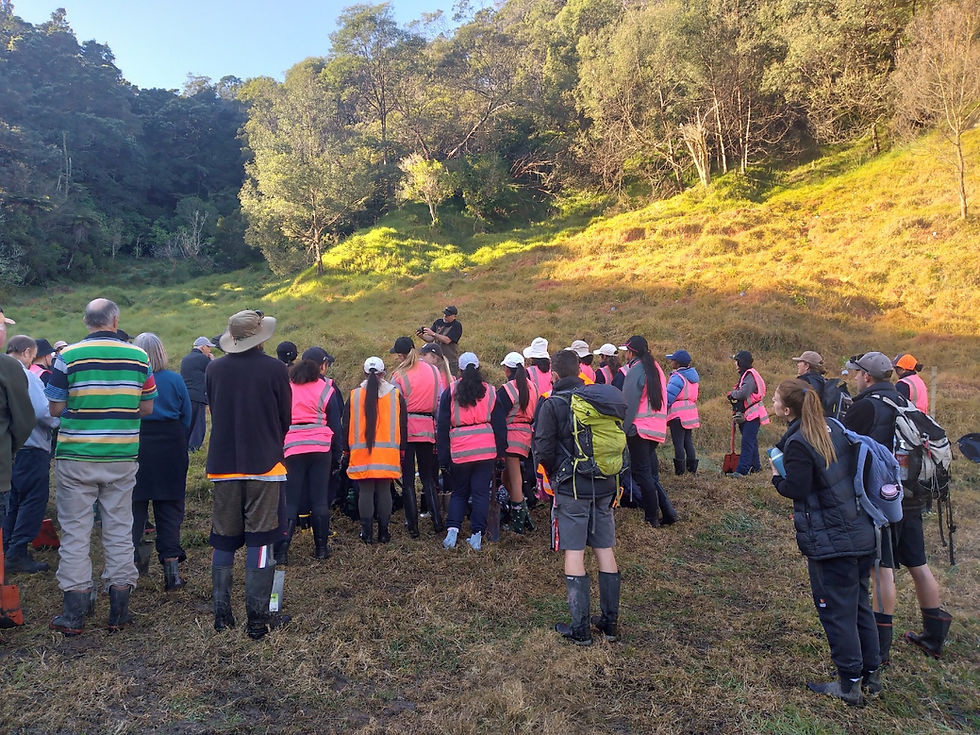
The first of annual plantings scheduled over the next five years took place in mid-July. On a beautiful sunny morning more than 50 volunteers gathered at the site to plant 2,000 trees, including manuka and akeake, along the fringes of the remnant bush. Prior to the work getting underway, Ken Barsdell acknowledged Te Hapu Oneone and Te Upokorehe and their association with their ancestral lands, in a karakia.
Locals were supported by a 30-strong contingent from St Cuthbert’s School in Auckland and their teachers. The Year 10 girls are spending a month at the school’s outdoor Kahunui campus in the Waiōtahe Valley. Their chitchat and excitement at every worm found while digging planting holes could be heard throughout the morning. Following the hard work, Andrew Glaser from the Ōhiwa Headland Sanctuary Trust led the volunteers a few metres into the remnant bush to demonstrate what could become of the small seedlings just planted - in about 100 years. He also pointed out the special wairua (spirit) that can be felt in this forest. Millie Cornelius, who is familiar with the area, explained the cultural significance of the bush which contains wāhi tapu (sacred areas). Several archaeological sites have also been recorded recently on this land.

This newly protected area extends a link towards the south, aiding a corridor for bird movements from the mountains of Te Urewera down the Waiōtahe Valley out to the coast. The migration corridor allows native birds to feed on large-fruited species like Karaka and Pūriri. The restoration work also assists in reducing sediments flowing into Ōhiwa Harbour. It is a win-win project on multiple levels.
The remnant bush is one of eight protected areas by the Queen Elizabeth II National Trust at Ōhiwa Harbour.


